

How to Know When Your Business Needs Better Warehousing and Logistics Support
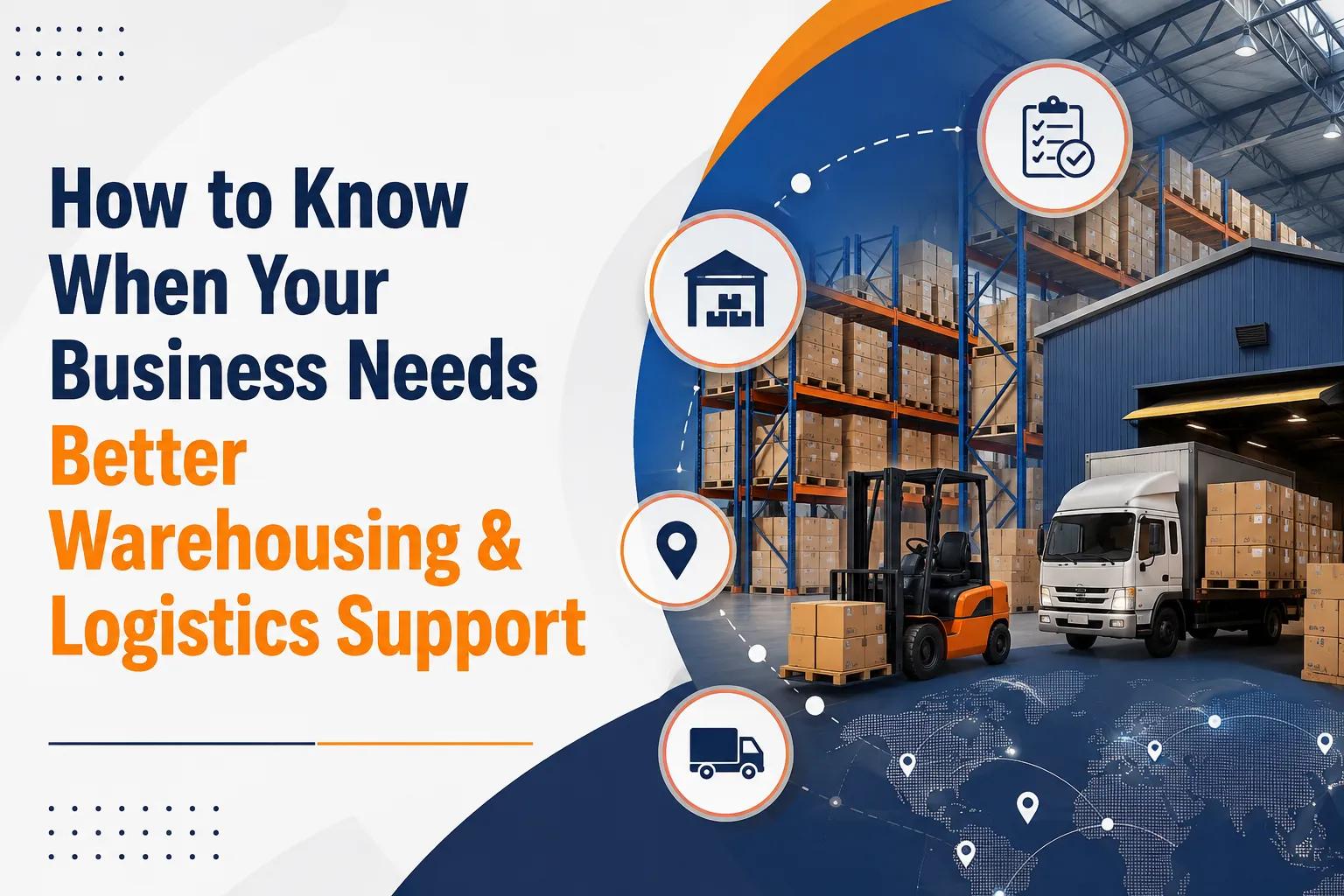
Warehousing and logistics can be relatively simple when a business is small. A limited amount of inventory, fewer orders, and a small delivery network are usually easier to manage.
As the business grows, however, those same processes can become harder to control. Delayed orders, inaccurate inventory, limited storage, and complicated deliveries can start affecting everyday operations.
So, how do you know when your current setup is no longer enough? Here are some signs worth paying attention to.
1. Your Storage Space Is Constantly Under Pressure
Running out of warehouse space is an obvious warning sign. But even when there is still some room available, poor organisation can make a warehouse difficult to work in.
If products are stacked wherever space is available or employees regularly move stock around to find what they need, your current setup may be limiting efficiency.
Look out for:
Crowded storage areas
Difficulty locating products
Poor use of available space
Stock being moved unnecessarily
Increasing storage requirements
The right warehousing and logistics services should provide storage that works with your inventory volume and how frequently your products move.
2. Your Inventory Records Are Becoming Unreliable
Inventory accuracy becomes increasingly important as the number of products and orders increases.
If your records show that an item is available but your team cannot find it, you may have a process problem rather than a simple counting error.
Common warning signs include:
Frequent stock discrepancies
Missing or misplaced products
Manual stock checks taking too long
Overstocking certain items
Running out of products unexpectedly
Better inventory processes can improve visibility and make it easier to understand what is available, where it is stored, and when it needs to be replenished.
3. Orders Are Taking Too Long to Process
A warehouse should help orders move smoothly toward dispatch. When picking, packing, or documentation starts taking too long, the warehouse can become a bottleneck.
This is particularly noticeable when order volumes increase.
Ask yourself:
How long does it take for a confirmed order to leave the warehouse?
If the answer has gradually increased, it may be time to review your storage layout, inventory processes, fulfilment workflow, or available support.
4. Delivery Delays Are Starting Before Dispatch
Not every delivery delay is caused by the transportation provider.
An order that spends too much time waiting to be picked, packed, or prepared for dispatch has already lost valuable delivery time.
This is why warehousing and logistics should be viewed as connected processes.
A more efficient flow should generally look like:
Storage → Inventory → Picking → Packing → Dispatch → Transportation → Delivery
If one stage repeatedly slows down the next, improving only the transportation side may not solve the underlying problem.
5. Your Business Is Expanding Into New Markets
Growth can change your logistics requirements quickly.
A business delivering within one city may have relatively straightforward needs. Expanding across India can introduce longer routes, different delivery requirements, and greater inventory coordination.
International expansion adds another layer.
Depending on the shipment, businesses may need to consider air freight services when speed is important or sea freight services when larger shipments can accommodate longer transit times.
The best option depends on factors such as shipment size, destination, urgency, product type, and budget.
6. Your Team Is Spending Too Much Time on Logistics
There is a difference between managing logistics and constantly fixing logistics problems.
If employees are regularly searching for stock, correcting inventory records, checking shipment statuses, or coordinating different delivery providers, those tasks can consume significant working time.
Consider how much effort your team spends on:
Manual inventory checks
Order preparation
Shipment coordination
Resolving delivery issues
Responding to tracking queries
When logistics starts taking attention away from core business activities, external support may be worth considering.
7. Your Products Need More Suitable Storage Conditions
Not every product can be stored in the same way.
Some goods may require controlled temperatures, specialised racks, pallet storage, additional security, or particular handling procedures.
This becomes especially important when your product range changes.
Before choosing warehousing services in India, consider the actual requirements of your inventory, including:
Product type
Storage volume
Handling requirements
Temperature needs
Security requirements
Frequency of stock movement
A suitable facility should match the products being stored rather than simply providing additional floor space.
8. Customers Keep Asking About Their Shipments
Repeated questions about shipment status can point to a visibility problem.
Customers generally want to know whether an order has been dispatched and when they can expect it. If your team has to manually check every shipment, customer-service workload can increase as order volumes grow.
Reliable tracking can make this process easier.
For businesses handling regular deliveries, parcel tracking in India can provide useful visibility after shipments leave the warehouse and help teams identify potential delays.
9. You Are Using Too Many Separate Logistics Providers
Using multiple providers is not necessarily inefficient. Different providers may be better suited to different regions, shipment types, or transportation methods.
The problem comes when coordinating them becomes unnecessarily complicated.
For example, a business might have separate arrangements for:
Warehousing
Domestic transportation
International freight
Order fulfilment
Shipment tracking
If employees are constantly moving between different systems and providers, an integrated logistics arrangement may make operations easier to manage.
10. Your Current Setup Cannot Keep Up With Growth
Sometimes the biggest warning sign is simple: your business is growing faster than your logistics process.
A system that worked well with a small number of weekly orders may become difficult to maintain when volumes increase significantly.
Think ahead and ask:
Could our current setup handle twice the order volume?
If the answer is uncertain, it is worth reviewing your warehouse capacity, fulfilment process, transportation network, and inventory systems before growth creates bigger operational problems.
What Should You Review First?
Before changing your entire logistics setup, identify where the actual problems are coming from.
Start by reviewing five areas:
Storage: Is your available space being used effectively?
Inventory: Can you quickly locate and verify your stock?
Fulfilment: How long does it take to prepare an order?
Transportation: Are you using suitable options for different shipments?
Visibility: Can your team and customers easily track deliveries?
This simple review can help you identify whether you need more storage, better processes, technology, additional logistics support, or a combination of these.
When Does Outsourcing Make Sense?
There is no universal point at which every business should outsource warehousing or logistics.
Some smaller businesses can manage their own operations efficiently. Others may need professional support earlier because they handle high order volumes, multiple locations, specialised products, or international shipments.
The decision should be based on operational needs rather than business size alone.
If your team is spending too much time managing logistics, your storage requirements are increasing, or your existing infrastructure cannot support expansion, outsourcing some or all logistics functions may be worth evaluating.
Final Thoughts
Better warehousing and logistics are not necessarily about having the biggest facility or using the most transportation providers.
What matters is having a process that keeps inventory organised, orders moving, shipments visible, and deliveries on track.
For growing businesses, warehousing and logistics services can provide additional capacity and operational support when an existing setup starts becoming difficult to manage.
Fastway India offers solutions across warehousing, distribution, fulfilment, freight, and shipment tracking. Businesses can assess these options based on their products, markets, shipment volumes, and longer-term logistics requirements.
The right time to review your logistics setup is usually before small operational problems become barriers to growth.